
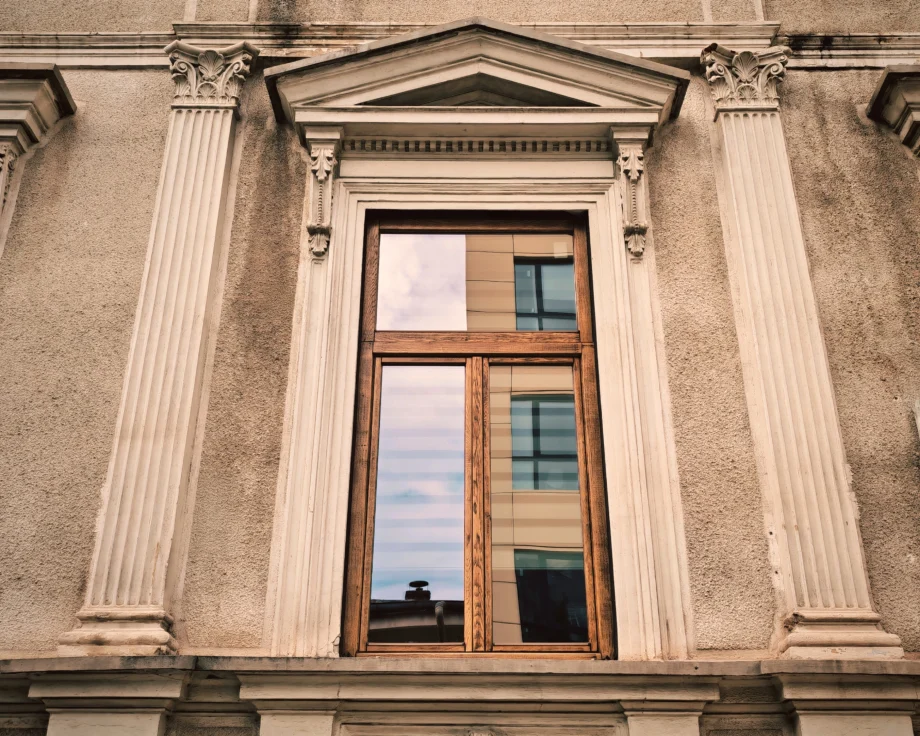
The biggest risk that arises when restoring a historic building and, in general, when conserving architectural heritage is preserving the identity of these values, both aesthetically and structurally. Not only the final visible result is important, but also the materials that will be used for the restoration, from the material for the windows to the re-insulation of the walls. And yes, a project like the one we present to you below is a real challenge, and the result, unaltered by compromises, is also the one that offers the greatest satisfaction. We say this not because we have read it in books, but because, at Tudor Workshop, I lived it! Now let's return to the title of this article: Restoring a Historic 1940s House: How We Transform an Interwar Building into a "Living Building" with Oak and Hemp, because that's what we're going to talk about.
When you set out to restore and rehabilitate a heritage building, you start from the idea that it must retain its „soul” and valuable vibration, but also take on a new life. How do you do that? By avoiding the use of cheap materials that can cause damage both aesthetically and technically. In short, when we restored the historic building built in 1940, in the center of Bucharest, we knew that for the windows we would use solid oak wood for the windows, under no circumstances PVC, that we would use dried hemp and magnesium formwork (MgO) for insulation and that to ensure energy efficiency and quality finishes to modern standards we would apply the rules of the NZEB (Nearly Zero Energy Building) standard. Let's talk at length…
Why Triple Layered Oak Joinery?
Because a building facade with heritage value deserves respect and because we have already seen in Bucharest (and not only) a lot of historical buildings that have become examples of monstrous kitsch after being fitted with PVC windows, with white PVC roller blinds! How much aesthetic unity there is between plastic and architecture from the interwar period... tell us that we fail to realize it.
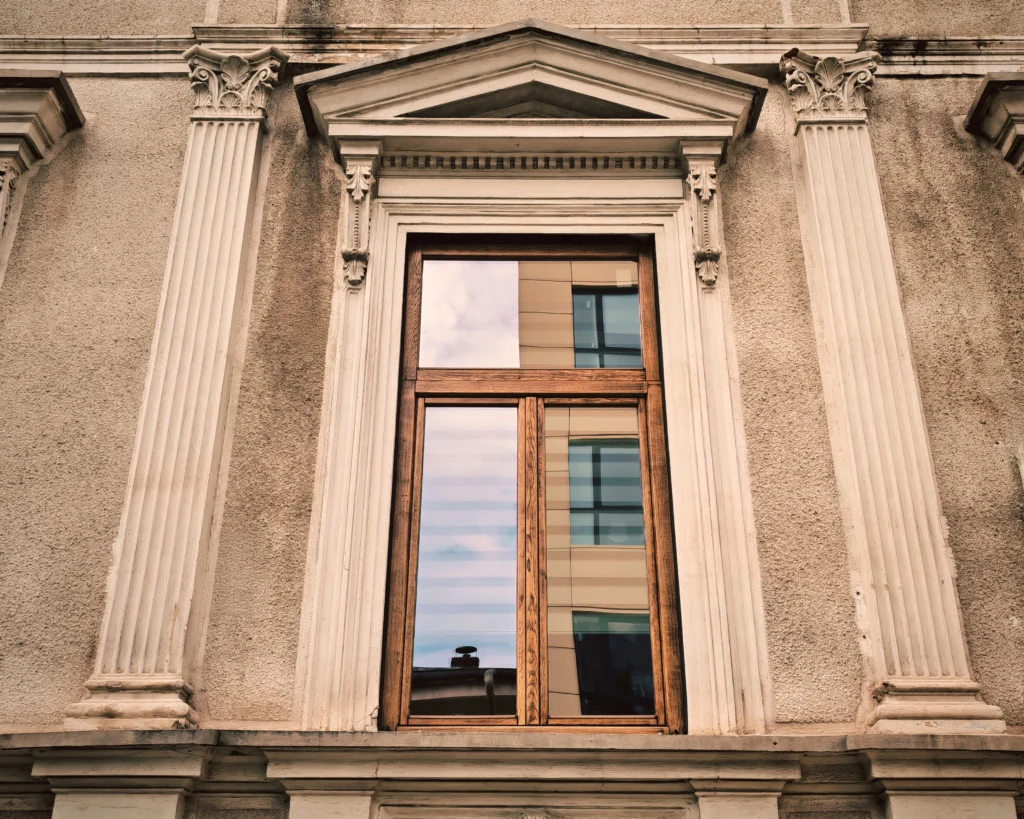
Okay, okay, but why is triple-layered oak the ideal solution for the windows of an old building? We are not exaggerating if we say that in the process of proper restoration, the old carpentry is replaced with a true functional work of art, which ensures the elegance and original proportions, but also exceptional thermal efficiency and sound insulation, while letting the building breathe! And, if another argument is needed, it is not difficult to demonstrate that, unlike PVC, oak is a natural, durable and renewable material. And to make everything as it should be, we used 4-season tripan glass for the frames.
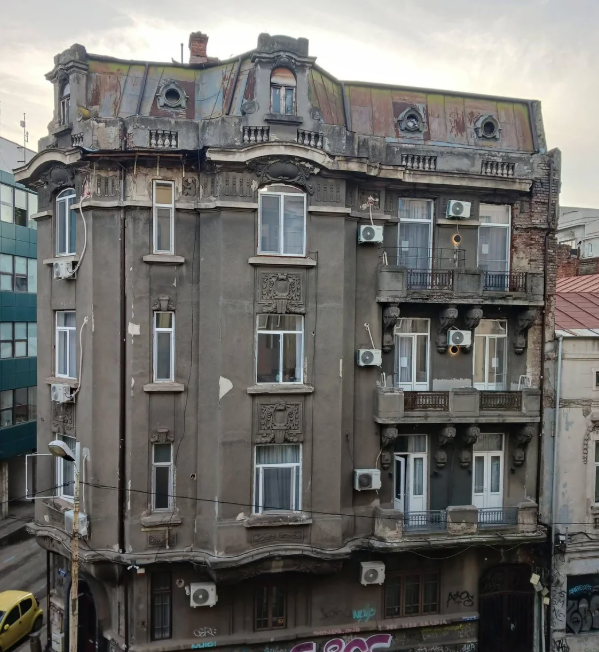
(Historic building destroyed with PVC)
Why hempcrete insulation and magnesium formwork?
Of course, changing the windows of a historic building is just one stage of the project. Any old building, heritage or not, needs, at some point, a restoration of the insulation and wall finishes. At Tudor Atelier we are dedicated to the concept of ecological restoration, because the habitat once returned to the people who will live or work here must be healthy. So in the restoration project in downtown Bucharest for the 1940 building we used CaNaDry dried hemp (produced by EXIE in Belgium), magnesium formwork (MgO), and for the final finish mineral paint.
Why?
While the formwork made of magnesium oxide plates (MgO) is stable and ecological, the insulation itself, for the installation of which we used, as mentioned above, dried hemp CanaDry, works as an outstanding natural thermal and acoustic barrier. Equally important, CaNaDry dried hemp is a fire retardant material and, in addition, offers a thermal lag of more than 16 hours (!), which means it has a fantastic ability to block heat penetration in the summer.
You'll ask why. dried hemp and not hemprete in this case, although they have similar properties? Because the solution we chose is equally efficient and environmentally friendly and is best suited to this project (hempcrete involves wet pouring and requires a longer time for drying and subsequent finishing).
Last but not least, we used mineral paint because it goes well with the CaNaDry dried hemp. Mineral paint is completely vapor permeable and not only prevents mold, but also keeps the air clean.
NZEB standard installation and traditional finishes
NZEB – Nearly Zero Energy Building means nothing more than meeting modern energy efficiency standards. However, in the case of a building built almost a hundred years ago, finding technical solutions to achieve this standard is no small feat. We are not bragging, but we are glad that we managed to overcome this obstacle. How?
Through impeccable execution and the use of technical solutions individually chosen for the project. Mainly, when we talk about NZEB, in addition to the quality materials used, it is also about choosing high-performance sealing solutions, such as special Bosig tapes and premium Penosil foam, used to ensure professional sealing around the oak joinery. Also in the NZEB chapter, glazing is very important. We chose 4S (4 Seasons) insulating glass, it provides perfect insulation, protecting the interior both against the cold in winter and against the hot summer days.
Lime and sand-based plasters
Any restoration of a heritage building practically involves a return to traditional materials such as lime or sand. In fact, this recall of the old craft is essential, otherwise there can be no restoration! Lime and sand allow the walls to breathe naturally, working in perfect harmony with the hemp insulation and preventing the accumulation of moisture in the old masonry structure.
A living, breathing building
By choosing solid oak instead of PVC and hemp (#hempcrete) instead of polystyrene, a 1940 house located in Bucharest becomes an optimized structure, safe and perfectly adapted to current comfort standards, without losing a single second of its identity and historical value.